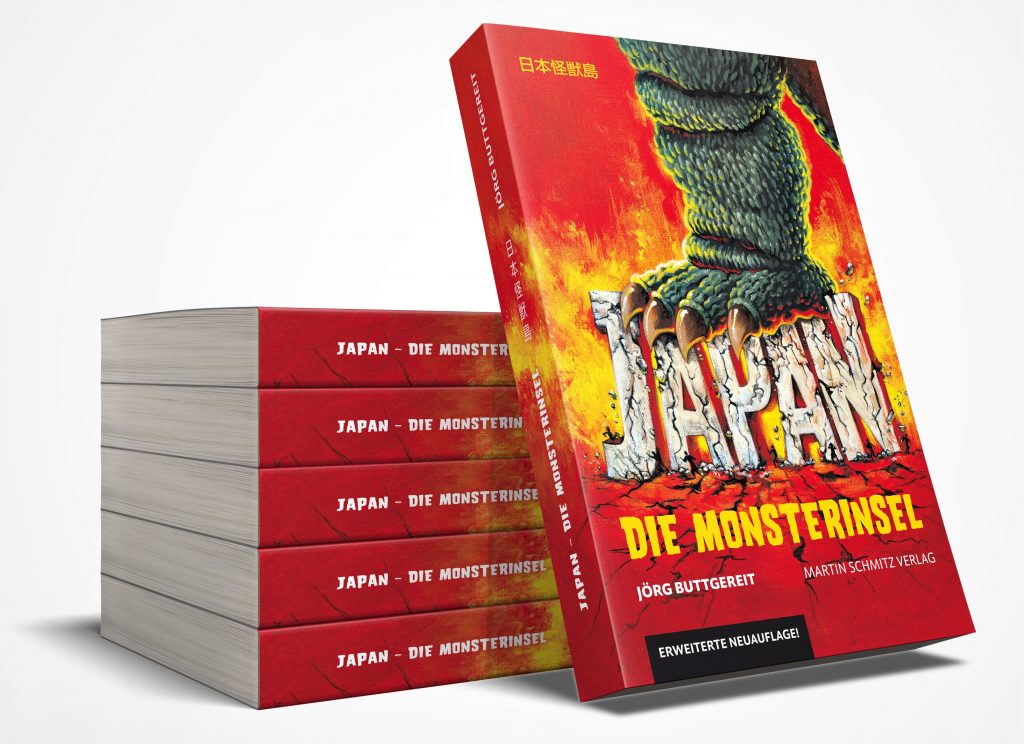

Japan - The Monster Island

or: everything you’ve always wanted to know about Godzilla & Co but were afraid to ask.

In between directing the first musical about the Ramones in Berlin, developing new radio plays for Germany’s WDR and being in the jury of renowned film festivals, notorious Berlin filmmaker Jörg Buttgereit went to Japan in order to do some serious research for his new book about the love of a lifetime, Japanese monster movies that is. Sven Fortmann had a chance to do a little G-talk with the man behind ‘Nekromantik’ on another grey afternoon in a never ending winter.

Would you say that your affinity to Japan is the result of watching Godzilla matinée's at a very early age?

There sure is a connection... after all it was my first encounter with Japan, right? I clearly remember going to the movies with my dad and my grandfather. (laughs) They hated these kind of movies, especially my grandfather thought that this was the biggest piece of crap he’d ever seen. But it wasn’t a Godzilla flick, it was a Gamera one, actually. Shigeo Tanaka was directing it in 1966... and what a beautiful job he did. Back then they named it ‘Godzilla-Der Drache Aus Dem Dschungel’... (laughs) and after they’d realized that there isn’t one single second of Godzilla in this movie, the German distributor changed the title to ‘Panik - Dinosaurier Bedrohen Die Welt’. By now you can get it as a flashy DVD for 4.99. The same film is now named ‘Dragon Wars’ and for whatever reason there are stills from a Godzilla movie from 1994 on the cover. Quite an odyssey for one movie, right? It’s just unbelievable how the German companies messed around with the titles... on the other hand you almost have to respect so much creativity. Later, they even taglined some Japanese monster movies ‘Frankensteins Dämonen Bedrohen Die Welt’ or ‘Frankensteins Kampf Der Ungeheuer’... that actually hasn’t anything to do with the movie itself, but who gives a shit.

I remember these matinée’s as well. The first one I saw was ‘King Kong vs Godzilla’... as a little kid I was heavily impressed by it, even though it left me a little confused as well. I was always waiting for King Kong to appear in the action.

Yep, that was quite bizarre to name the robot ‘King Kong’, especially since we are clearly dealing with Mecha-Godzilla here... this film in particular is quite confusing and irritating for a kid. Remember that fantastic ‘Planet Of The Apes’ rip-off in the same movie? There are these aliens, right, the ones that live beyond the ‘Pferdekopfnebel’... (laughs) the Japanese just bought a dozen of a very popular American Halloween mask and used them to ‘create’ their aliens. These masks were easily available from every ‘Famous Monsters’ store back then... that’s pretty mad, isn’t it? There’s this website, I think it’s ‘tokyo-monsters.com’, and there you can find loads of pics from Japanese DVD’s and stuff... (laughs) and there you’ll find lots and lots of pics of this guy in a silver battlesuit wearing this notorious mask, and he’s making lots of stupid karate moves. It’s hilarious. I’m still asking myself if they were actually aware of what they’re doing back then or if they were completely clueless. I was talking to Noriyaki Yuasa, the guy who directed lots of Gamera movies in the late 60’s/early 70’s, and he told me that retrospectively, he’s quite impressed by the level of naivety of everyone involved. It always seemed as if the filmmakers just started to think about the movie a few hours before the first take. ‘Wow, we’re making a monster movie... dammit, that could be quite complicated’.

Personally, what do you find most fascinating about these kinda movies? The naivety? The level of innocence?

I’m heavily fascinated by the fact that they haven’t changed the concept over so many years... it’s still a guy in a rubbersuit. Remember Roland Emmerich’s take on Godzilla for the US and how he tried to avoid any kind of artificial look? It’s the exact opposite of what Japanese monster movies are all about... over there, they don’t have the slightest problem with artificiality.

Would you say that you’re fascinated by the imperfection of these movies as well?

That’s a major misunderstanding... these movies are absolutely perfect! It’s just a completely different way of filmmaking. Things aren’t supposed to look real or true-to-life, they just have to look beautiful. And a miniature version of a certain landscape very often looks more beautiful than the real thing... it’s all a question of aesthetics. If you think about it, you will agree that in the very majority of living-rooms, you won’t find big prints of photographs on the wall... it’s more likely to find paintings that somehow copy reality. The traditional Japanese theatre is very artificial as well... so it’s a cultural-historic thing, right?

After the success of the first Godzilla movie, more and more monsters were developed... was that done because of commercial aspects only?

Sure. The second Godzilla movie already had an extra monster named ‘Angilas’... and it was a successful movie. I think you could say that Japanese film companies are fundamentally getting active only when there's money involved... pretty unromantic, isn’t it? I experienced that when I was making the documentary on Japanese monster flicks, when I was making interviews for the book. When I first addressed to them, there was no interest from their side at all, simply because there wasn’t any big money involved. Just after it became clear that the WDR (German regional television station) is buying bits and pieces for the documentary, I was allowed to talk to certain people. (laughs) At first, they wanted me to pay for the interviews as well... unbelievable. If I had taken some photographs on the set, I had to pay for them as well. If I had filmed some stuff on set, it would have cost me $2.500 per minute. For stuff I would have shot myself!
There is this story about a German Godzilla fan that was writing a letter to Toho where he expressed his love and admiration for the movies... he wrote it on selfmade Godzilla note paper. As a result he got a dissuasion for using a protected trademark. That’s fucking crazy, but that’s how they roll. In my book I had to mention as well that nothing is authorized from Toho... and that’s why there isn’t a single still from the original movies but magazine covers, pics I shot myself and advertising stuff. I learned how to be careful after I made the documentary for WDR in 2002... you have no idea about the legal string that followed after the broadcast. Everyone was really happy about the documentary but broadcasting it for a second time is absolutely taboo because it would be too expensive. Doing business with them is as hard as nails, man. When I was finally invited to visit Toho’s studios, I was meeting this producer... and the first thing he said to me was ‘Germany... there are so many Godzilla bootlegs in Germany’. It’s not about that he’s happy that I was coming all the way from Germany to do a couple of interviews.

Isn’t that super frustrating... you’re very enthusiastic and having best intentions because you’re doing a documentary and a book and all you get is business talk?

It certainly is... but I really wanted to do the film and the book. Whenever I was meeting someone privately, especially after they were released from their contract with Toho, getting an interview wasn’t a problem at all. Even the guy who’s building the Godzilla-suits told me that it’s a petty that I arranged the interview through Toho, because now he’s just allowed to talk for fifteen minutes. That’s really sick, right?! When I tried to get an interview with Haruo Nakajima, the guy who’s playing Godzilla from 1954-1972, through Toho, they just told me that he’s not working for them anymore and that they are not giving me his details. Of course not, because they won’t earn a single penny from doing so. So I found the majority of people either by myself or through other fans... and you can easily tell that the Godzilla-community is pretty pissed off about Toho’s behavior. Here’s another anecdote: there’s this convention in Chicago and they would’ve loved to screen a Godzilla movie or two... once again, Toho wasn’t interested because there’s no money to be made from. So they said, alright, no problem, you could do one single screening but it costs you guys a four-digit number of US dollars. As far as the figures go you just can’t do that, of course. But the convention was getting bigger over the years and all of a sudden it was possible to do a screening and Toho had to deliver the movie. I was there and it was really fun to sit in an old theatre with 1000 other fans and watch an old Godzilla classic. (laughs) It’s also quite an experience to literally hear the dollars dropping while the film projector clatters.
I got a lot of addresses in Japan through the publisher of ‘G-Fan’ as well. A couple of years ago, this magazine was doing a little competition... something like ‘Draw Your Own Godzilla Comic’, and the best ones are getting printed and stuff. As you probably already have guessed, there was a letter from Toho coming, talking about license fee’s. As a result there were three pages of monster comics without Godzilla in a Godzilla fanzine. It was a relief to see that not everyone is like that... the studio and directors that were responsible for the Gamera films were super cooperative and really friendly. Visiting the studios and doing interviews wasn’t a problem at all. Ten minutes of snippets and trailers that I used for the documentary were as expensive as one minute of material from Toho. Plus I got lots of Gamera dolls and autographs from the director and stuff.

Is it actually true that Godzilla loves to destroy miniature buildings from a certain real life architect?

(laughs) I’m not really sure about that. I once talked to a guy that played several monsters in his career and he told me that he’s more into accidently destruction... as if the monster was at the wrong place at the wrong time and not this larger than life aggressor. I think it’s because nowadays the monster genre changed from being a h-bomb metaphor to being a metaphor for natural disasters.

How long have you actually worked on the book?

Phew, that’s hard to tell. I think I did the first interviews in 1998/99 in Montreal... whenever I was visiting film festivals and knew that there are people invited that were or are still involved in making monster movies, I was doing interviews. It’s always easier to talk to these guys at festivals... (laughs) because they got already paid to be there. I was making an interview with Jan DeBont when he’s promoting the so-so ‘The Haunting’. But since I knew that he was originally supposed to direct the American Godzilla movie, we were mainly talking about that instead.
I find it pretty fascinating that the Japanese monster movies are heavily entertaining, but the studios on the other hand seem to suffer from a lack of humor... it’s a bit like Disney, I think.

Let's talk a bit about your 8th radio play that has its grande premiere really soon. What is it all about?

It’s called ‘Captain Berlin vs Dracula’ and it’s about... well, in 1973 Adolf Hitler’s brain is transplanted into a robot. He’s trying to get behind the secret of eternal life and so he’s teaming up with Dracula because this guy obviously already knows about it. But Dracula is from an Iron Curtain country and so they’re having some differences. Anyway, then there’s our hero Captain Berlin who was born in 1933 as the secret weapon of the resistance movement against national socialism. He’s living incognito but got sucked into the story because Dracula is kidnapping his virgin daughter. It’s almost an installment of the Captain Berlin film I was doing in 1982. It’s fairly bizarre... so I guess I gave the WDR a hard time once again. But after it became clear that Bela B. (from Germany's mega-selling band 'Die Ärzte') is playing Dracula, it wasn't too hard to get their ok anymore.

Jörg Buttgereit interviewed by Sven ‘Fortyounce’ Fortmann

Please note that this book is only available in German language

Jörg Buttgereit & Friends
Japan - Die Monsterinsel / The Monsterisland
Martin Schmitz Verlag
256 pages, Hardcover
ISBN 978-3-927795-44-0
Euro 24.50