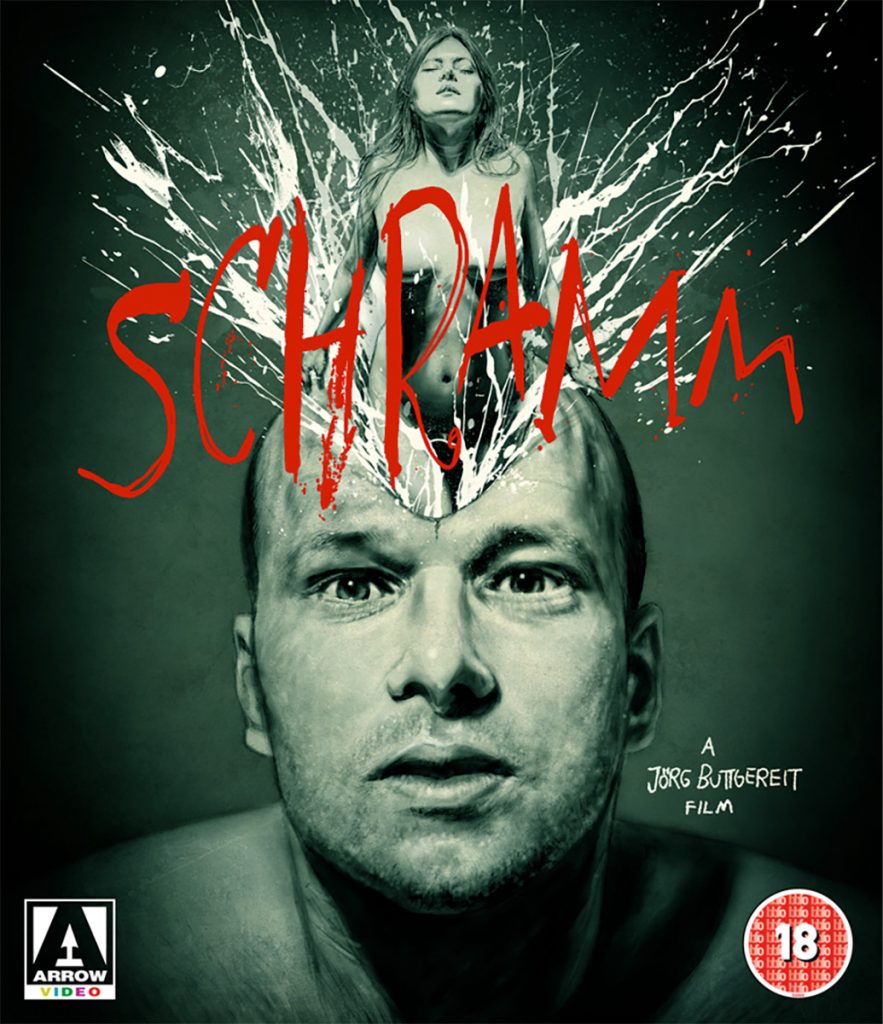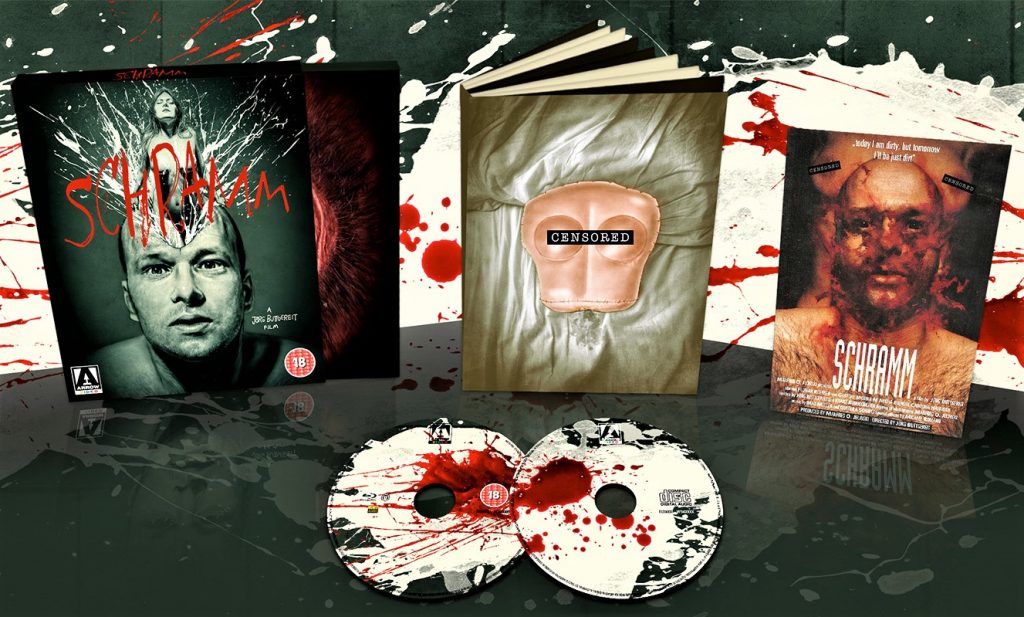

SCHRAMM - INTO THE MIND OF A SERIAL KILLER
Lothar Schramm (Florian Koerner von Gustorf) is dying, face down in a pool of his own blood. Behind his closed eyes, fractured memories repeat themselves in a neuronal fire. He runs by the sea. He lusts after the whore (Monika M) across the hall. He staggers through life uncertainly. He kills.
SCHRAMM is the story of the notorious “Lipstick Killer” Lothar Schramm’s last days on earth. Revealed in a series of tightly constructed flashbacks, the film offers an unflinching look into the mind of a serial killer. A haunting study of frustration and violence. Uncompromising in its depictions of violence and perversion, Schramm is a poetic masterpiece guaranteed to make you squirm.
Buttgereit takes the serial killer genre, and breaks it open into something no filmmaker has ever accomplished as successfully; the entering of the mind of a mass murderer. Due to this, not much emphasis is illustrated on the killer’s actually killings, but rather his inner torment, and thought processes.
SCHRAMM follows a non-linear structure which superbly complements its visual style and storyline. Many scenes are repeated throughout. This combined with hallucinatory footage produces a perfect chaotic environment in which a serial killers mind must reside. For this budget range, there is no holding back as far as creative cinematography goes.
Many sequences in this grim film are shot beautifully. Several scenes involve very innovative ways of capturing a shot, which include a slowly rotating scene. I honestly can’t find anything lackluster about this film. SCHRAMM portrays stellar acting between the stunning Monika M., and rather vicious and sympathetic Florian Koerner. The cast and crew all do a great job with the film.
Chris Mayo
SCHRAMM is a disjointed, confusing and repellant journey into the mind of a serial killer, which manages to be surprisingly smart at the same time. Directed by Germany’s Jorg Buttgereit, a horror maestro whose films tend to collect bans instead of awards, it’s definitely not for the squeamish, easily offended, or for that matter, those who don’t like to pay very close attention for an hour. Unlike mainstream movies like MANHUNTER, which purport to take the audience inside the head of a madman, SCHRAMM actually does. The entire film is told in a chaotic, stream of consciousness series of flashbacks from the point of view of the title character, who is dying.
Schramm, played by von Gustorf, demonstrates all the textbook symptoms of psychosis and schizophrenia. The film conveys his fractured state of mind with its editing and camerawork, which reflect his inability to assemble even the simplest of thoughts into cohesive ideas. His self perception is warped: he sees himself at various stages with normal legs, or with one crippled in a brace, or amputated. Only one is right; the point is, we can’t be sure, because our subjectivity is limited to his point of view.
The flashback concept is important to hold onto throughout…it lends some sense of structure, however loose, to the often violent and perverse imagery. Why else would we see him bandage the bridge of his nose in one sequence, when he doesn’t sustain the injury until his fatal fall? Perhaps structure is too strong a word; a better one might be pattern. The lines between illusion and fact are constantly blurred. There is a repeated motif of Schramm waking up, which often seems to punctuate the end of one scene and open another. Is he waking from fantasy to reality, or vice versa? Again, he doesn’t know, and therefore, neither do we.
What motivates Schramm? Some kind of psycho-sexual torment that seems to grow from his lust and love for a young hooker (Monika M). With perhaps a bit of homage to Martin Scorsese’s TAXI DRIVER and Neil Jordan’s MONA LISA, Schramm takes her from appointment to appointment, but the knowledge of what goes on behind those closed doors seems to be making him more unsettled. I remember one scene where he listens to her make love through the wall, while releasing his tensions with a novelty store prop, which he later carefully cleans while the sounds continue.
The camera often seems to reflect his state of mind. Images blur, or stationary objects are lingered upon too long for comfort. In a tense scene with the unconscious girl, the entire scenario plays out with the camera looking straight down on them from above, as though Schramm were having an out-of-body experience.
Though unrated, this picture is clearly NC-17 material, if not stronger. Buttgereit is a filmmaker that revels in the horrific and shocking, and there are images in this movie that will stay with you for a long time. The fact that there are equal and copious amounts of sex and violence in the film might be disturbing enough for some; even more so is the fact that the two are almost indistinguishable in the mind of the protagonist.
Von Gustorf’s performance is interesting in that it ends up completely enigmatic. There are moments we fear him, there are others that almost coax sympathy, but no single note is sustained long enough for us to form a viable opinion. In the end, one could argue that Buttgereit got the exact acting job he was looking for out of von Gustorf in the editing room.
So be warned…SCHRAMM is definitely a movie for a select audience. The sensitive viewers won’t enjoy it at all, but ironically, some seasoned horror fans might be put off by the confusing and purposely muddled structure. It plays like looking at a jigsaw puzzle with the pieces put together completely wrong and a number of pieces missing. But the pieces are there; they’re the ones Buttgereit forces you to bring to the table.
Michael Jacobson
"Today I am dirty, but tomorrow I'll be just dirt"
The film is presented in a distinctive non-linear style - in fact, it's told almost entirely in reverse. If you've seen Chris Nolan's 'groundbreaking' MEMENTO then you'll know how well this format can work: at first needlessly confusing, but ultimately rewarding and begging of a second viewing. Just bear it in mind that SCHRAMM came several years earlier than Nolan's celebrated effort!
But where SCHRAMM differs thematically is in it's regular revisits to the title character's present incapacitation, making SCHRAMM appear at times less of a story-told-backwards, and more a study into the mechanics of someone who, on his death-bed, is searching for a reason to the madness that has punctuated his final week on Earth.
The storyline to SCHRAMM may be sparse, and you may be tempted to think that any film offering it's ending at the beginning and then working back-over would amount to a redundant viewing exercise. You're wrong. SCHRAMM is superbly written (by Buttgereit and Franz Rodenkirchen - the team responsible for NEKROMANTIK!) and Buttgereit's direction is especially impressive as he manages to toy with conventional audience expectancies, while keeping the narrative coherent and - most importantly - interesting. Full kudos to the music of Schmitz and Müller too - very atmospheric.
That the film is told in reverse does not spoil the building tension in the plot at all, and even if the more astute see where it's all leading - you're sure to have fun getting there! SCHRAMM is one of the finest genre efforts in the last two decades. I also personally hold it alongside DER TODESKING as Buttgereit's crowning achievement. Yeah, NEKROMANTIK's cool ... but this is so good, you almost forget about key scenes such as the dentist dream sequence (great eye gouging), or the merciless slaying of the two Bible-bashers! And the disembodied vagina that sprouts yellow teeth - well, that's gotta be seen to be believed!!
SCHRAMM is a low-budget exercise in genre film-making, shot on 16mm film in German. It's also rife with violent and sleazy moments, yet the overall feeling it will leave you with is something artistically satisfying and an agreeable change from the norm. In fact, it's a travesty that SCHRAMM never won the director any greater accolades than directing the odd episode of LEXX ...! This film deserves more recognition not only for it's undeniable genre-pleasing shock value, but it's artistic merit. Buttgereit's talent shines through in all departments!
Stuart Willis
Staff:
Directed by Jörg Buttgereit
Written by Jörg Buttgereit & Franz Rodenkirchen
Produced by Manfred O. Jelinski, Jörg Buttgereit
Cast:
Florian Koerner von Gustorf
Monika M.
Micha Brendel
Carolina Harnisch
Director of photography: Manfred O. Jelinski
Editing: Manfred O. Jelinski, Jörg Buttgereit
Music: Max Müller & Gundula Schmitz
Special effects: Michael Romahn
Optical Effects: Manfred O. Jelinski
Best boy: Jan Hartmann
Assistent director: Franz Rodenkirchen
Poster art: Micha Brendel
Stills: Jörg Buttgereit
1993, 70 mim.